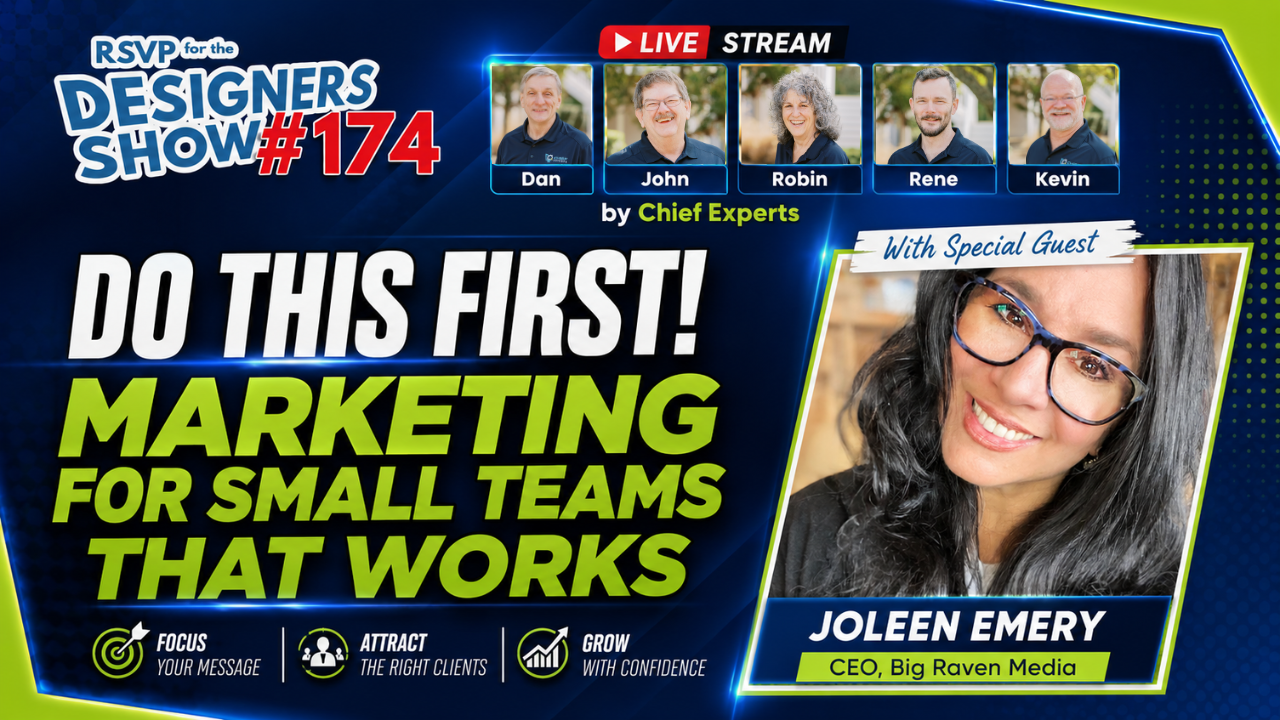
In this episode of the Designers Show, Dan Baumann and Rene Rabbitt of Rabitt Design joined guest Joleen Emery of Big Raven Media for a practical conversation about marketing for small teams, especially designers, remodelers, builders, and Chief Architect users who do not have a dedicated marketing department.
The discussion stayed grounded in a simple reality: most small design businesses do not need more marketing noise. They need the right foundation, maintained consistently, so potential clients can find them, understand them, and trust them quickly.
For many small teams, the first move is not another social media post. It is not chasing every new platform. It is making sure the basic digital structure is actually in place and working.
Start With the Marketing Foundation
One of the clearest points from the episode was that “bad marketing” is often not bad because the effort is useless. It is bad because it is out of order.
A designer or remodeler may spend hours creating social media content while their Google Business Profile is incomplete, unverified, inactive, or missing reviews. That is upside-down marketing. The business is spending energy on visibility in places where people may or may not be looking, while neglecting the place many customers use first when they need a service.
For small teams, the recommended starting point is simple: set up the Google Business Profile, verify it, fill it out properly, and continue feeding it with useful updates.
That means adding photos, posts, articles, promotions, links to blog content, project examples, and clear business information. The point is not to make Google complicated. The point is to help the “machine” understand what the business does so it can show the business to people searching for those services.
For Chief Architect users and design professionals, the language used in the profile matters. Many clients do not know what design software is being used. They are more likely to search for terms tied to their own goals, such as design-build, ADU, remodeling, luxury homes, home design, or related service terms. The profile should describe the business in the language customers actually use.
Treat Google Like a Platform, Not a Listing
A Google Business Profile should not be treated as a one-time setup task. The episode framed it more like a platform that needs regular attention.
Once the profile is verified, it should be part of the weekly or monthly marketing habit. Posting once a week was discussed as a practical rhythm. That post could be a project photo, a short update, a blog link, or another piece of useful content that helps Google and potential clients understand the business.
This matters because people often go to Google first when they are trying to solve a problem. If a designer, remodeler, or builder has not given Google enough information, the business becomes harder to discover.
The message was direct: feed the machine.
That does not mean overcomplicating the process. It means building a habit around the most important digital real estate first, before spending too much time on channels that may not be producing leads.
Reviews Need a Workflow, Not Wishful Thinking
Reviews were another major part of the conversation. The episode did not treat reviews as a passive bonus. Reviews are something a business has to ask for, guide, and build into its workflow.
Many businesses know reviews matter, but they do not ask consistently. That is the real problem. The answer is not just to “remember” to ask. The answer is to create a workflow where asking for a review happens every time.
The discussion also made the point that review goals will vary by business type. A retreat center with hundreds of guests has a different opportunity than a designer or remodeler who may only work with a smaller number of clients each year. Still, the takeaway was clear: aim for progress. Twenty-five or thirty good reviews would be meaningful for many design businesses, and working toward one hundred creates a stronger base of social proof.
The habit is what matters.
A designer with seventeen strong reviews is in a better position than one with none, but if that designer has completed many more successful projects, the online profile is underrepresenting the real business. Awards, project success, and happy clients should not stay hidden. They should show up where future customers are already looking.
Make It Easy for Clients to Leave Reviews
The episode also covered practical ways to make reviews easier.
A business can use a direct review link, turn that link into a QR code, and place it somewhere clients can access easily. Business cards, follow-up emails, service materials, or in-person prompts can all help move a client from good intention to completed review.
The wording matters, too. The ask does not need to be awkward or pushy. It can be framed honestly: leaving a review takes a little effort, but it helps the business significantly.
That small explanation can make the request feel more human. Clients who had a good experience often want to help. They just need to be asked clearly and given an easy path.
A Bad Review Is Not the End
The episode also dealt with one of the reasons people avoid asking for reviews: fear of a negative one.
A one-star or two-star review is not ideal, but it is not necessarily fatal. What matters is how the business responds. A thoughtful, calm response can become part of the business’s credibility. Prospective clients often read the response as much as the review itself.
The advice was not to panic. If the review is from someone who never bought a product or service, or if it is clearly inaccurate, the business can keep pushing for removal through the platform. But when a bad review remains, the response becomes the story. It shows whether the business is professional, accountable, and willing to address concerns.
That response is public marketing.
Social Media Is Often Brand Awareness, Not Lead Generation
Social media came up as a common source of confusion. The episode made a useful distinction: social media can support brand awareness, but it should not automatically be treated as a lead-generation engine.
Unless a business is tracking where leads come from, social media may function more like a sign in the yard. It lets people know the business exists, but it may not be what drives actual customer inquiries.
That does not mean social media is useless. For some businesses, especially where the owner is willing to be the visible expert and voice of the brand, it can work well. But it requires a real strategy. It is hard to outsource the expert voice entirely, because the content needs to reflect what the designer, builder, or remodeler actually knows and does well.
For many small teams, the better order is this: get Google working, make the website clear, build reviews, then use social media as a supporting channel.
Referrals Are Valuable, But They Are Not a Strategy
Word of mouth is common in the design and remodeling world. Many businesses survive on referrals for years. The episode did not dismiss referrals; it challenged relying on them alone.
Referrals are strong because they come with built-in trust. Past clients already know the business, and they can send people who are more likely to listen. But referrals alone can become “wish marketing.” The business hopes people will talk, hopes they will remember, and hopes the timing works.
That is not the same as having a consistent marketing system.
A stronger approach is to pair referrals with intentional marketing activity. That could include staying in touch with past clients, asking for reviews, keeping Google updated, tracking lead sources, and making the website easier to understand. None of that requires a massive marketing department. It requires a repeatable habit.
Past Clients Are Often the Easiest Place to Start
One practical point from the episode was the value of relationship marketing.
It costs more effort to find a brand-new client than it does to reconnect with someone who already knows, likes, and trusts the business. Past clients have experience with the business. They understand the process. They may have another project in mind or know someone who does.
Reaching out to former clients when there is room in the schedule is not complicated. It is a way to restart conversations with people who already have context.
For remodelers, designers, and Chief Architect professionals, that can be one of the most direct ways to create new work without starting from zero.
Trust Comes From Consistency Across Digital Real Estate
Another core lesson was that online trust is built through consistency.
When a potential client looks at a business on Google, Facebook, Instagram, Yelp, or the company website, the business should feel like the same business everywhere. Logos should match. Phone numbers should be correct. URLs should work. Branding should feel aligned. Photos and banners should support the type of work being sold.
The point is not perfection. The point is continuity.
If the business presents high-quality design or construction services, the online presence should look cared for. A designer’s website, Google profile, and social platforms should reflect the same level of attention the client expects in the actual work.
For designers especially, the first impression matters. The digital presence should show taste, clarity, and competence quickly.
The Website Must Be Clear Fast
The episode put strong emphasis on website clarity. A visitor should understand who the business is and what it sells within seconds.
The homepage, especially the area above the fold, is valuable real estate. It should not make visitors work too hard. The business needs to communicate the basic message immediately: who they serve, what they do, and how someone can take the next step.
If a site is confusing, people leave. If the page does not quickly answer the visitor’s question, the business may lose the lead before the conversation starts.
This is especially relevant for Chief Architect users, designers, and remodelers because clients may not understand technical distinctions. They need a clear explanation of the service, not a maze of insider language.
Tire Kickers Can Be Managed With Clear Positioning
The conversation also addressed tire kickers. The advice was direct: a business may need to repel the wrong fit in order to attract the right fit.
That can mean stating project minimums, charging for design services, or being clear about the kind of work the business takes on. When a business says projects start at a certain level, lead volume may go down. But that may be fine if the leads being filtered out were never a fit.
There is a tradeoff. Some consumers do not understand what projects cost, and there may be moments where education is needed. But if a business is consistently spending time with people who are not serious, not qualified, or not aligned with the service, clearer positioning can protect the schedule.
Charging for Design Services Can Improve Lead Quality
Charging for design services was also discussed as a practical filter. Giving away plans, bids, and estimates can create a huge time drain. When the business charges for that work, even a modest amount, it changes the conversation. People who are serious are more likely to continue. People who only wanted free expertise often disappear.
That is not a loss. That is a filter working.
Track Where Leads Come From
Marketing gets sharper when the business knows what is actually working.
The episode encouraged asking every lead how they heard about the business and keeping track of the answer. It may feel awkward, but the data matters. If leads are coming from Google, Yelp, referrals, social media, a website contact form, or job signs, the business should know that.
Google Analytics was also discussed as a separate tool from the Google Business Profile. Analytics can show which pages people land on, how long they stay, what pages convert, and where people leave.
That information helps the business make better decisions. Instead of guessing, the business can put more energy into the channels and pages that are already creating traction.
AI Can Help, But It Does Not Replace the Basics
AI came up several times, but the episode’s stance was measured. AI can help with marketing, but it should not distract from the fundamentals.
Before using AI to improve a Google profile or review a website, the business still needs to set up the profile, verify it, add information, ask for reviews, and maintain the digital foundation.
AI can also be useful for reviewing website pages, but the advice was to go page by page rather than dumping everything in at once. Even then, a human review still matters. AI may identify something addressable, but it does not fully replace a real person landing on the site and reacting to the impression it creates.
A useful question for a human reviewer is simple: what is the vibe when landing here?
That kind of reaction matters because customers are humans, not models.
Consistency Beats Start-Stop Marketing
The final lesson was consistency.
Small business owners often get excited and decide to do too many things at once. Then client work gets busy, the marketing stops, and the pattern repeats. The episode pushed for a smaller, more sustainable approach.
Instead of trying to do everything, the business should decide what it actually wants. Is the goal brand awareness? More leads? Better lead quality? Once the goal is clear, the next step is to choose a few action steps and stick with them.
Consistency matters because marketing compounds. Start-stop marketing wastes energy. A steady rhythm helps the business show up at the right time with the right message when a potential client is ready.
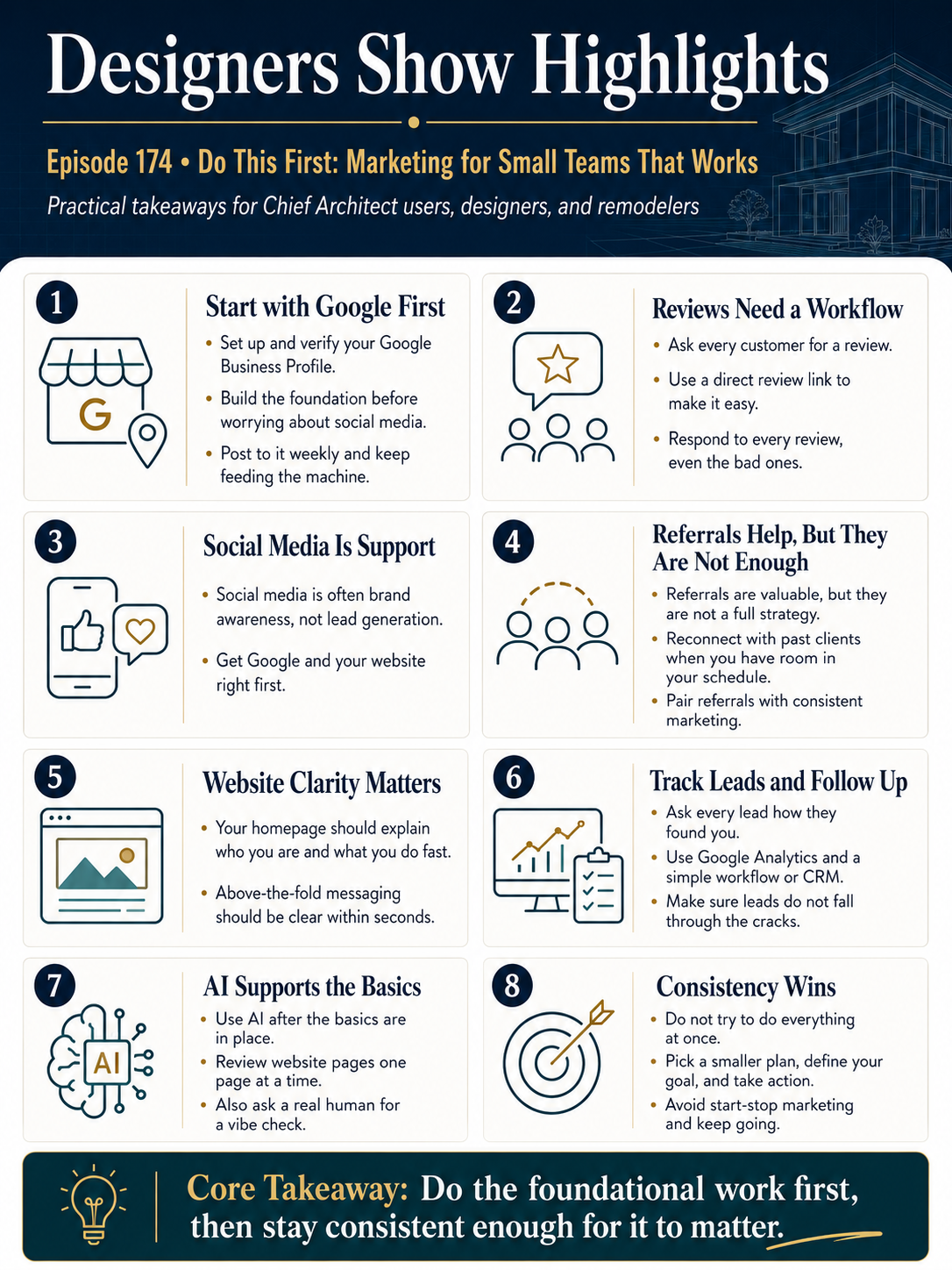
For small design teams, remodelers, and Chief Architect professionals, the practical path is not mysterious. Get the Google Business Profile right. Ask for reviews. Keep the website clear. Track leads. Use social media intentionally. Stay in touch with past clients. Keep going.
The episode’s strongest takeaway is also the simplest: do the foundational work first, then be consistent enough for it to matter.